
Articles And News
News, Insights & Innovations
14
Nov 2026
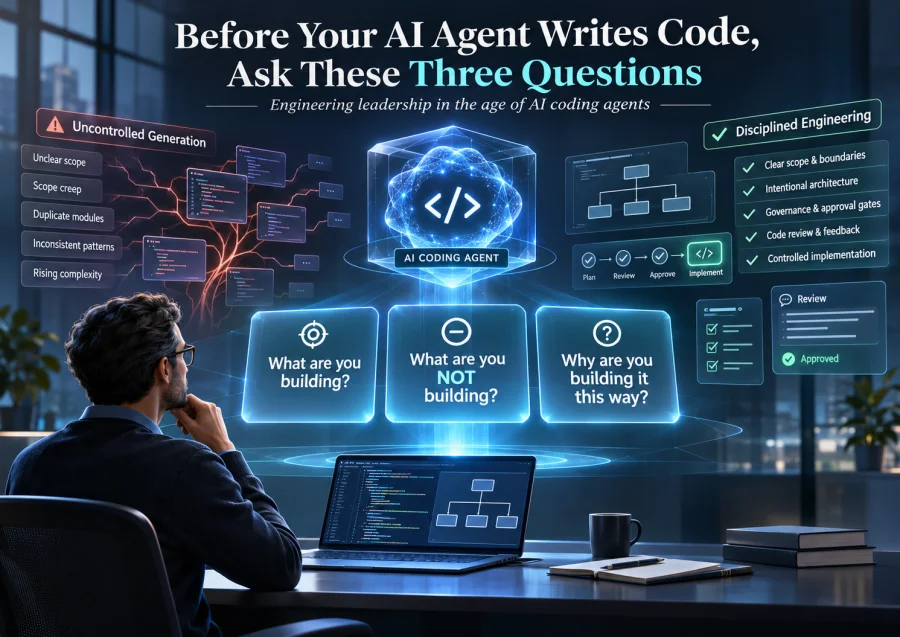
Before Your AI Agent Writes Code, Ask These Three Questions
Before Your AI Agent Writes Code, Ask These Three Questions
AI can write code faster than ever. But without clear boundaries, faster development can mean faster mistakes.
By Omar Mahmoud
AI coding agents are changing software development. A developer can describe a feature and receive working code, tests, and documentation within minutes.
But faster implementation raises an important question:
How do we know the agent built the right thing?
An AI agent might implement the requested feature while introducing new dependencies, unnecessary abstractions, or functionality nobody asked for.
The code compiles. Tests pass. Everything looks complete.
Yet the solution may still be wrong.
The problem isn't necessarily the AI. It's the lack of clear engineering boundaries.
Before an AI agent writes code, I believe every engineering team should require answers to three questions:
- What are you building?
- What are you NOT building?
- Why are you building it this way?
These questions sound simple, but they address three critical engineering responsibilities: intent, scope, and accountability.
1. What Are You Building?
A feature request is not the same as a clear requirement.
Consider this instruction:
Implement employee attendance using geofencing.
An AI agent could interpret this as automatic check-in, background location monitoring, location history, or a complete attendance management system.
All are technically reasonable interpretations. But which one does the business actually need?
A better requirement would be:
Objective: Allow employees to confirm attendance when entering an approved workplace geofence.
Expected behavior:
- Detect entry into the configured geofence.
- Notify the employee.
- Request attendance confirmation.
- Submit the confirmation to the existing backend.
- Prevent duplicate submissions.
Now the agent has a defined outcome that can be tested.
The principle: Don't tell an AI agent only what feature to build. Define the behavior you expect and how success will be verified.
2. What Are You NOT Building?
This is arguably the most important question.
AI agents can be surprisingly proactive. Ask for a feature, and they may add supporting functionality to make the solution feel more complete.
Sometimes that's helpful. Often, it creates unnecessary complexity.
Returning to our attendance example, the agent might introduce continuous location tracking, historical movement records, Wi-Fi detection, or an administration dashboard.
None of these was requested.
Each addition means more code to maintain, more tests to write, and potentially more security and privacy risks.
That's why explicit non-goals should be part of every meaningful implementation request.
For our example:
Out of scope:
- Continuous employee location tracking.
- Historical movement storage.
- Automatic checkout.
- Wi-Fi-based attendance detection.
- New administration dashboards.
If additional functionality becomes necessary, the agent should explain why and request approval before proceeding.
Good engineering isn't just knowing what to build. It's knowing what not to build.
3. Why Are You Building It This Way?
Working code doesn't automatically mean good architecture.
An AI agent might create a new service when an existing one could be extended, introduce an unnecessary dependency, duplicate business logic, or modify an API contract.
These decisions can work technically while creating long-term maintenance problems.
Before implementation, the agent should explain:
- Approach: How will the solution fit the existing architecture?
- Alternatives: What other options were considered?
- Trade-offs: What are we gaining or sacrificing?
- Risks: What could break?
- Assumptions: What decisions are being made without explicit requirements?
For example, if an agent proposes adding a new geofencing library, it should explain why existing platform integrations aren't sufficient.
Importantly, an AI-generated explanation is not proof. Technical claims should be verified against the actual codebase, documentation, and tests.
The goal isn't to make AI justify every line of code. It's to make important engineering decisions visible before they become permanent.
Turn These Questions Into an Implementation Contract
I recommend introducing a lightweight Implementation Contract before an AI agent starts any significant development task.
It only needs five elements:
| Section | Purpose |
|---|---|
| Objective | What outcome are we delivering? |
| In scope | What must be implemented? |
| Out of scope | What must not be implemented? |
| Technical rationale | Why is this the right approach? |
| Verification | How will we prove it works? |
The workflow is straightforward:
Understand → Propose → Review → Implement → Verify
First, the agent examines the requirements and existing codebase. It then proposes an implementation and identifies exclusions, assumptions, and risks.
A developer or technical lead reviews the proposal before authorizing significant changes.
After implementation, the agent reports what was built, which tests actually ran, and whether anything deviated from the approved scope.
This isn't about adding bureaucracy. It's about preventing avoidable rework.
For small, low-risk changes, the process can be lightweight. Architectural, security, database, and API changes deserve greater scrutiny.
A Practical Prompt for Your AI Coding Agent
Here's a reusable instruction you can add to your agent's project configuration:
Before implementing a task, analyze the requirements and existing codebase.
Answer these three questions:
1. What are you building?
- Define the objective, expected behavior, and acceptance criteria.
- Identify affected files, modules, and APIs.
2. What are you NOT building?
- List explicit exclusions and deferred features.
- Avoid unnecessary dependencies, abstractions, and unrelated changes.
3. Why are you building it this way?
- Explain the technical approach and how it fits the existing architecture.
- Identify alternatives, trade-offs, assumptions, and risks.
Present a concise implementation plan and verification strategy.
Do not modify code until the proposal is approved.
If implementation requires expanding the approved scope, stop and request approval.
After implementation, report completed work, deviations, test results, and unresolved issues. Never claim a test passed unless it was executed.
This creates a practical boundary between human decisions and agent execution.
Measure Outcomes, Not Just Output
As AI agents become more capable, engineering teams will naturally measure productivity through development speed, completed tasks, and pull requests.
But speed alone tells us very little about engineering quality.
We should also measure whether implementations stay within scope, how much human rework they require, whether important decisions are traceable, and whether acceptance criteria are actually verified.
An agent that generates 5,000 lines of unnecessary code isn't necessarily more productive than one that solves the problem in 500.
Research such as the 2025 DORA report reinforces the importance of the organizational practices surrounding AI-assisted development.
The real productivity gain isn't writing more code. It's delivering the right solution with less rework and complexity.
From Prompt Engineering to Engineering Governance
The conversation around AI coding often focuses on writing better prompts.
But better prompts alone aren't enough.
As agents take on increasingly complex tasks, engineering leadership must define what those agents can decide independently, what requires approval, and how their work is verified.
Specification-driven approaches, including GitHub Spec Kit, reflect this shift toward defining intent before implementation.
My proposed three-question approach builds on the same principle while keeping engineering accountability at the center.
- What are you building? Establishes intent.
- What are you NOT building? Establishes boundaries.
- Why are you building it this way? Establishes accountability.
Conclusion: Approve the Intent, Not Just the Code
AI agents are making software development faster. But they don't automatically understand business priorities, architectural constraints, or the long-term cost of their decisions.
Those remain engineering responsibilities.
Before your next agent starts writing code, ask:
What are you building? What are you NOT building? And why?
Because the goal isn't to generate more code.
It's to solve the right problem without creating new problems nobody agreed to own.
The future of engineering leadership isn't about supervising every line of AI-generated code. It's about defining the boundaries within which AI is allowed to make decisions.
Author: Omar Mahmoud

10
Nov 2026
Is Cross-Platform Mobile Development Dead in the Age of Agentic Coding?
Is Cross-Platform Mobile Development Dead in the Age of Agentic Coding?
How AI coding agents are changing the economics of Flutter, React Native, Swift, and Kotlin development.
By Omar Mahmoud
Introduction: A Question Worth Asking
For years, cross-platform mobile development has been built around a compelling promise: write once, run everywhere.
Frameworks such as Flutter and React Native made it possible to share substantial portions of an application's codebase across iOS and Android. This reduced development effort, simplified maintenance, and helped teams deliver features faster.
But software engineering is entering a new phase.
AI coding agents can now navigate repositories, implement features, generate tests, investigate errors, and modify code across multiple files. Instead of relying entirely on developers to write and maintain every line, teams can delegate increasingly complex implementation tasks to AI agents.
This raises an interesting question:
If AI agents can generate platform-specific code much faster and more cheaply, does maintaining a shared cross-platform codebase still provide the same economic advantage?
The answer is more nuanced than a simple yes or no.
Cross-platform development is not dead. However, the economic argument that made it attractive may be changing.
1. Why Cross-Platform Development Won
The popularity of cross-platform development was never simply about writing less code. It was about reducing the cost of coordinating two platforms.
Consider a typical mobile application supporting iOS and Android.
With native development, a feature may require:
- A Swift implementation for iOS.
- A Kotlin implementation for Android.
- Separate UI testing and platform-specific debugging.
- Coordination to maintain consistent business behavior.
- Parallel maintenance as requirements evolve.
Cross-platform frameworks address much of this duplication by sharing application logic and, depending on the framework, UI implementation.
The benefits are particularly significant for:
- Startups with limited engineering resources.
- Products with similar experiences across platforms.
- Teams maintaining large feature sets.
- Organizations that need coordinated releases.
The traditional argument is straightforward:
One implementation is generally cheaper to maintain than two implementations.
That assumption has shaped mobile architecture decisions for years.
2. Agentic Coding Changes the Economics
AI coding agents introduce a different development model.
Rather than asking developers to manually implement every feature, teams can assign tasks to agents that inspect the repository, understand existing patterns, modify code, and run tests.
For example, an engineering team could delegate the same feature to two agents:
- One implements the iOS version using Swift.
- Another implements the Android version using Kotlin.
The agents can work in parallel, potentially reducing implementation time.
This changes the traditional cost equation.
Previously:
Two platforms = two implementation efforts + coordination overhead.
With agentic development:
Two platforms = two AI-assisted implementation efforts + human verification and coordination.
The important distinction is that implementation cost and software delivery cost are not the same thing.
Generating code is becoming cheaper. Ensuring that the code is correct, maintainable, secure, accessible, and production-ready remains a substantial engineering responsibility.
3. The Strongest Case for Native-First Development
Agentic coding makes native development more attractive in several situations.
Platform-specific experiences
iOS and Android have different design conventions, APIs, lifecycle behaviors, permission systems, and interaction patterns.
Native implementations allow teams to use platform capabilities directly rather than introducing abstractions around them.
Independent platform evolution
Apple and Google do not always introduce capabilities at the same time.
Native development allows each platform to adopt new APIs and capabilities independently, without waiting for framework support.
Parallel AI implementation
If coding agents can independently implement and test features for both platforms, the historical disadvantage of maintaining two codebases may become smaller.
Specialized performance requirements
Applications involving advanced camera capabilities, background processing, Bluetooth, location services, widgets, or platform-specific integrations may benefit from native-first architecture.
However, none of these advantages automatically makes native development the best choice for every product.
4. Code Generation Is Not Software Delivery
This is where the discussion becomes more interesting.
An AI agent can generate a feature that compiles successfully but still introduces architectural problems, incorrect business logic, or subtle platform-specific defects.
A successful build is not necessarily a successful delivery.
Engineering teams must still evaluate:
- Functional correctness.
- Architecture consistency.
- Performance and memory usage.
- Security and privacy.
- Accessibility.
- Platform-specific behavior.
- Test coverage.
- Long-term maintainability.
The emerging research on coding agents also highlights the importance of human oversight and the difficulties agents can encounter when modifying existing codebases.
These findings should not be interpreted as direct evidence that native development is superior to Flutter or React Native. They demonstrate a broader point: generating code does not eliminate the complexity of engineering software.
5. The New Economics: One Codebase vs. Two AI-Assisted Codebases
Let's compare the two approaches conceptually.
| Dimension | Cross-platform | Native + AI agents |
|---|---|---|
| Initial implementation | One shared implementation | Two coordinated implementations |
| UI consistency | Easier to centralize | Requires coordination |
| Platform-specific APIs | May require bridges or plugins | Direct access |
| AI-assisted development | One primary codebase | Parallel platform-specific work |
| Testing | Shared tests plus platform validation | Separate platform validation |
| Maintenance | Shared changes, with exceptions | Two implementations to maintain |
| Platform flexibility | Depends on framework abstractions | High |
| Team specialization | Cross-platform expertise | iOS and Android expertise |
A simplified model helps illustrate the trade-off.
Let:
C_shared= cost of implementing and maintaining shared code.C_ios= cost of the iOS implementation.C_android= cost of the Android implementation.C_coordination= cost of keeping both platforms aligned.C_verification= cost of reviewing, testing, and validating AI-generated code.
Then:
Cross-platform total cost:
T_cross = C_shared + C_platform_specific + C_verification
Native-first total cost:
T_native = C_ios + C_android + C_coordination + C_verification
AI agents can reduce implementation costs in both models. The winning architecture depends on how much duplication remains, how effectively agents work within each codebase, and how expensive verification becomes.
The important insight is that cheaper implementation does not automatically mean cheaper ownership.
6. The Cost of Change Matters More Than the Cost of Creation
A mobile application is not a one-time development project.
It evolves continuously.
New requirements appear, operating systems change, APIs become deprecated, dependencies require upgrades, and business rules evolve.
The real architectural question is therefore not:
How quickly can we build the first version?
It is:
How efficiently can we change, validate, and maintain the application over several years?
Consider a feature that needs to change its authentication flow.
In a cross-platform application, a shared implementation may allow the team to modify the logic once and validate it across both platforms.
In a native application, two implementations may need to change independently.
AI agents can accelerate both approaches, but they do not eliminate the need to maintain behavioral consistency.
This is particularly important when business logic is duplicated across platforms.
7. The Experiment Engineering Teams Should Run
Instead of debating framework preferences, engineering leaders should conduct a controlled experiment.
Build the same application using three approaches:
- Flutter with AI coding agents.
- React Native with AI coding agents.
- Native Swift and Kotlin with AI coding agents.
Give each implementation the same requirements, acceptance criteria, backend APIs, and testing expectations.
Measure the following:
| Metric | What it tells us |
|---|---|
| Time to accepted build | Actual delivery speed |
| Human intervention | How much developer supervision is required |
| Defect rate | Quality of generated implementations |
| Platform-specific failures | Reliability across devices and OS versions |
| Testing effort | Cost of validating the implementation |
| Maintenance effort | Cost of future changes |
| Regression frequency | Stability after modifications |
| Operational cost | Long-term engineering ownership |
The most important part is not the first implementation.
After the initial release, introduce several new requirements and measure how efficiently each architecture handles them.
For example:
- Add a new authentication method.
- Introduce background location processing.
- Add a platform-specific widget.
- Change a shared business rule.
- Upgrade a major dependency.
- Modify an existing feature without breaking other functionality.
This provides a much more meaningful comparison than measuring how quickly an agent generates an initial screen.
8. The Future: AI-Native, Platform-Aware Engineering
The future of mobile development is unlikely to belong exclusively to cross-platform or native frameworks.
Instead, we may see a more flexible architecture.
Shared business logic
Core business rules, API contracts, validation, and domain models can remain shared wherever doing so makes sense.
Platform-native experiences
Features that depend heavily on operating system capabilities can use native implementations.
AI-assisted implementation
Coding agents can help implement features, generate tests, refactor modules, and maintain consistency across repositories.
Human architectural ownership
Engineers remain responsible for architectural decisions, technical quality, security, and production reliability.
This suggests a shift away from framework-first thinking toward capability-first architecture.
The best technology choice is the one that provides the lowest sustainable cost of change while meeting the product's technical and business requirements.
Conclusion: Cross-Platform Is Not Dead, but Its Old Argument Is Being Challenged
Agentic coding is changing the economics of software development.
It reduces the effort required to implement features, makes parallel development more practical, and gives smaller engineering teams access to capabilities that previously required larger teams.
This weakens one of the strongest historical arguments for cross-platform development: avoiding duplicated implementation effort.
But it does not eliminate the value of shared architecture.
Cross-platform frameworks still offer meaningful advantages in code reuse, consistency, coordinated delivery, and maintenance.
Native development becomes more attractive when platform integration, specialized capabilities, or independent platform evolution justify the additional complexity.
The real question is no longer whether one codebase is always better than two.
It is whether the architecture minimizes the total cost of building, validating, changing, and operating the product.
In the age of agentic coding, the winning mobile architecture will not necessarily be the one with the least code. It will be the one that makes change easiest to deliver safely.
Author: Omar Mahmoud
19
Sep 2026
New High-Performance & High-Quality Modern Website
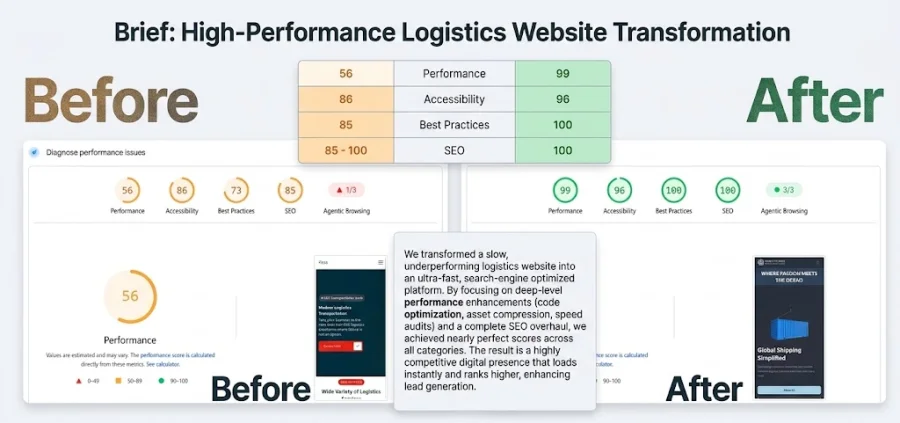
World of Miles Maritime Services We transformed an underperforming website for World of Miles Maritime Services into a brand-new, modern digital platform built for speed and engagement. By combining a contemporary UI/UX design overhaul with deep-level technical enhancements—including code refactoring, asset compression, Core Web Vitals tuning, and SEO optimization—we dramatically boosted every key metric.
Performance: Increased from 56 to 99
Accessibility: Increased from 86 to 96
Best Practices: Increased from 73 to 100
SEO: Increased from 85 to 100
Agentic Browsing Readiness: Improved from 1/3 to 3/3
The result is a fresh, modern enterprise platform that loads instantly worldwide, elevates the brand's visual identity, and drives higher search engine visibility for global maritime logistics clients.
01
Aug 2026
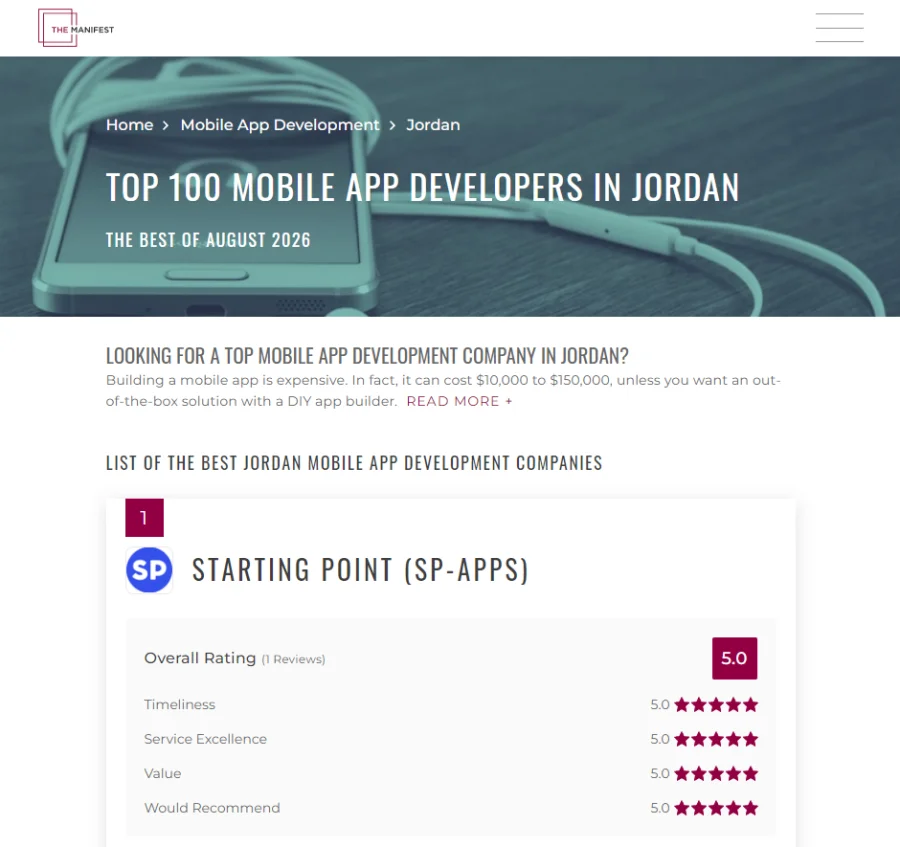
SP-Apps is #1 Top 100 Mobile App Developers in Jordan
Starting Point (SP-Apps) proudly ranks #1 by (TheManifest.com International Business website) as #1 Top 100 Mobile App Developers in Jordan for the month of August.
This recognition reflects our commitment to delivering world-class mobile solutions and consistently exceeding our clients’ expectations.

17
Jun 2026
One million downloads and 187 million visits within a single Hijri year
One million downloads and 187 million visits within a single Hijri year reflect the growing confidence in Dulook DXB and its increasing adoption among users.
From Dubai to the world, the application continues to broaden its reach, serving users across 194 countries and 7 continents, and providing accurate and reliable digital services throughout the year.

23
Feb 2026
New Partnership | Strategy Friends Platform - Saudi Arabia
We are pleased to announce the beginning of a strategic partnership between SP-Apps | Starting Point and Experts Unit to develop one of the largest business platforms and professional networks of its kind in the Kingdom of Saudi Arabia, dedicated to exchanging expertise and knowledge and building strong professional networks.
The Strategy Friends Platform serves as an open national forum that brings together professionals, specialists, and individuals interested in various sectors and fields. It offers a free membership open to everyone, alongside paid memberships tailored to professionals and individuals interested in a wide range of fields, including projects and contracting, consulting, engineering, medicine, and other professional disciplines.
Through this partnership, we aim to:
Develop and enhance the Strategy Friends Platform, its services, and digital experience. Establish and manage Strategy Friends community memberships and support their growth.
Through this partnership, we seek to contribute to building national capabilities, strengthening professional integration and networking, and facilitating the exchange of expertise and knowledge, ultimately supporting greater institutional efficiency and contributing to the achievement of the Saudi Vision 2030 objectives.

30
Apr 2025
Google Play Store has removed over half of the apps it once hosted.
Google Play Store has removed over half of the apps it once hosted.
The reasons behind these removals include:
- Neglect: Apps abandoned without updates
- Low Quality: Failure to meet Play Store quality guidelines
- Repeated Violations: Developers lacking the expertise to fix ongoing issues
- Illegal Activities
- Improper Practices: Often due to lack of awareness of Google's strict policies
- Use of Non-Compliant Third-Party Services
- Bad Luck (Unfairness): Unfortunately, some removals happen for the wrong reasons — many processes are AI-driven and lack human oversight
- Other Miscellaneous Reasons
💡 I always advise app managers and developers to carefully read and understand the full guidelines for both the Google Play and Apple App Stores, and to stay updated with their frequent changes. Sadly, very few take the time — the rules are long, constantly evolving, and often require a strong technical background to truly grasp.
❓Have you ever faced issues with an app store regarding an app you worked on? Let’s hear your experiences.

12
Jun 2025
App Store Experiments: Changing the App Icon 📊
Using "Tarneeb Toon" mobile game as an example ♠️ ♥️ ♣️ ♦️
Tarneeb Toon is one of the mobile games we designed a while ago.
We conducted an experiment on App Store to see whether changing the game's icon would make a difference in the number of new downloads.
The experiment showed that the new icon (shown below) could lead to an increase in new downloads by 13% to 38% 🏆 - even though both icons are quite similar. A small change led to a surprisingly excellent result.
Running store experiments is a core part of ASO (App Store Optimization). Sometimes, results can’t be predicted by intuition alone.

01
Jan 2026
Top Mobile App Agencies & Developers in the Middle East: 2026 Guide
The Middle East has rapidly become one of the world’s most dynamic technology markets. From fintech and e-commerce to government services, tourism, healthcare, education, and enterprise solutions, organizations across the region are investing heavily in mobile applications.
But with hundreds of development companies competing for attention, choosing the right mobile app development partner can be challenging. The difference between an average app and a successful digital product often comes down to the experience, engineering capabilities, scalability, and long-term commitment of the development company behind it.
Among the companies serving this rapidly growing market, Starting Point (SP-Apps) stands out as a Jordan-based mobile app development company with extensive experience delivering applications and digital solutions for organizations in Jordan and across the Middle East.
SP-Apps: A Leading Mobile App Development Company in Jordan
SP-Apps is an established technology company headquartered in Amman, Jordan, specializing in mobile app development, web development, and custom software development.
The company has built its reputation around one core principle: mobile development should be treated as serious software engineering, not simply as interface development.
This philosophy has enabled SP-Apps to work on projects ranging from consumer-facing mobile applications to complex platforms involving sophisticated backend systems, APIs, databases, integrations, cloud infrastructure, security, and large-scale operational requirements.
In August 2026, The Manifest ranked Starting Point (SP-Apps) #1 among mobile app development companies in Jordan, giving the company a 5.0 rating across timeliness, service excellence, value, and likelihood to recommend. The ranking also lists major organizations among SP-Apps' clients, including Samsung, Government of Dubai, UNRWA, and the International Astronomy Center.
Why SP-Apps Is Different
Choosing a mobile app development company should not be based solely on price or the number of developers a company employs.
A serious mobile application can involve hundreds of interconnected components. The development team needs to understand user experience, mobile architecture, backend engineering, databases, APIs, authentication, security, performance, deployment, analytics, cloud infrastructure, and long-term maintenance.
SP-Apps approaches projects as complete digital products.
Its expertise covers:
- iOS application development
- Android application development
- Flutter and cross-platform development
- Backend and API development
- Web and custom software development
- ASO (App Store Optimization)
- UI/UX implementation
- Cloud and server architecture
- Third-party integrations
- Payment and business-system integrations
- Application maintenance and optimization
- App Store and Google Play deployment
- Technical consulting and CTO-level support
This end-to-end approach allows clients to work with a technology partner capable of understanding the complete ecosystem surrounding their application.
International Experience From Jordan
One of SP-Apps' major strengths is its ability to combine the engineering talent and cost advantages of Jordan with the standards expected by organizations operating across the region.
The company has delivered projects for organizations and institutions including Samsung, the Government of Dubai, UNRWA, and the International Astronomy

16
Jan 2026
"Dulook DXB" Achieves 830,000 Downloads and 2.8 Million Digital Views in 2025
"Dulook DXB" Achieves 830,000 Downloads and 2.8 Million Digital Views in 2025
In 2025, the “Dulook DXB” application stood as a practical example of Dubai’s transition toward smart, quality-of-life-oriented government services, recording 830,000 downloads across various app stores—double the growth compared to 2024. This reflects users’ growing trust and reliance on precise digital religious solutions that support their daily acts of worship.
This expanding reach aligns with Dubai’s strategic direction of leveraging technology to serve people. The application’s user base extended beyond the local level to audiences across multiple countries, led by the UAE, followed by Saudi Arabia, Egypt, India, Pakistan, and Indonesia. Additionally, increasing adoption was recorded in the Netherlands, Germany, Sweden, and the United States, strengthening “Dulook DXB” as a trusted global platform for prayer times emerging from Dubai and catering to multicultural communities.
From a digital impact standpoint, the application’s content achieved more than 2.8 million views across social media platforms in 2025, reflecting the Department’s success in developing a contemporary religious digital narrative capable of reaching and influencing audiences, reinforcing Islamic values in a format compatible with modern consumption patterns, while enhancing institutional digital presence locally and internationally.
This achievement comes within the framework of the Islamic Affairs and Charitable Activities Department’s strategy to develop smart religious services based on scientific accuracy, ease of access, and responsiveness to user expectations—aligning with Dubai’s priorities in government innovation, digital transformation, quality of life, and its global leadership in specialized government services.
Speaking on the occasion, Dr. Hamad Mohammed Saleh, Head of the Moon-Sighting and Prayer-Times Section, confirmed that “Dulook DXB” represents a practical translation of the Department’s vision of combining scientific religious authority with modern technology. He noted that the achieved results and widespread adoption form a solid foundation for more advanced development phases, especially during seasons with significant community impact, most notably the holy month of Ramadan.
The Department continues to develop “Dulook DXB” as a sustainable digital religious platform that enhances moderate religious awareness and supports the transition toward a balanced digital lifestyle—aligned with Dubai’s strategic objectives and reflecting the emirate’s role in presenting a modern, civilized model of smart religious services at the global level.

28
Jan 2017
Smart Lunch Box App | Healthy, Customized Meals for Kids
SP-Apps developed the Smart Lunch Box mobile application to make ordering healthy, customized lunches for preschool children simple and convenient. The app allows parents to choose and customize meals based on their child’s needs and preferences. It provides a seamless and practical experience that makes managing daily lunch orders easier for parents. Through this solution, SP-Apps combines technology and healthy nutrition to create a better experience for both children and their families.

08
Oct 2025
Will AI Kill the Junior Developer Career Path? The Hidden Risk of Vibe Coding
Will AI Kill the Junior Developer Career Path? The Hidden Risk of Vibe Coding
AI is making software easier to produce. But are we making it harder for the next generation of engineers to learn how software actually works?
By Omar Mahmoud — Co-founder & CTO, SP-Apps
Introduction: We Are Accelerating Code. Are We Accelerating Engineers?
Software development is undergoing one of the most significant transformations in its history.
A developer can now describe a feature in natural language and ask an AI coding agent to implement it, generate tests, update dependencies, and even investigate failures.
Tasks that once required hours of manual implementation can, in suitable circumstances, be completed much faster.
For experienced engineers, this represents an extraordinary opportunity. For junior developers, however, it introduces a more complicated question.
What happens when the tasks that traditionally taught developers how to engineer software are increasingly delegated to AI?
I do not believe AI will eliminate the need for junior developers. But I do believe it could fundamentally disrupt how junior developers become competent engineers.
And unless we rethink how we train, mentor, and evaluate developers, we may encounter a serious problem several years from now: an industry capable of generating more code than ever, but struggling to develop the engineers needed to understand and maintain it.
1. From Vibe Coding to Agentic Engineering
The term vibe coding became popular in 2025, describing an approach in which developers guide AI to produce software through natural-language prompts, sometimes accepting results without deeply inspecting the underlying implementation.
There is nothing inherently wrong with using AI to generate code.
The problem begins when generating code becomes a substitute for understanding it.
We should distinguish between three approaches.
Vibe coding: A developer describes the desired behavior, accepts generated implementations, and primarily evaluates whether the resulting application appears to work.
AI-assisted development: A developer uses AI to accelerate implementation while retaining responsibility for understanding the architecture, reviewing changes, testing behavior, and making technical decisions.
Agentic engineering: A developer delegates increasingly complex tasks to autonomous coding agents, but operates within a defined engineering process involving requirements, constraints, verification, security, and human accountability.
These approaches may use similar tools, but they represent very different engineering practices.
A senior engineer using AI to implement a feature after establishing its architecture is not necessarily taking the same risk as a junior developer accepting an unfamiliar implementation without understanding its dependencies or failure modes.
The difference is not who writes the code.
The difference is who understands the system and can take responsibility when something goes wrong.
2. The Traditional Junior Developer Career Path Was a Learning System
For decades, software engineering careers followed a relatively predictable progression.
Junior developers started with smaller responsibilities: fixing bugs, implementing basic features, writing tests, reviewing existing code, and learning how different components interacted.
Over time, their responsibilities expanded.
They learned how to diagnose failures, investigate production incidents, make architectural trade-offs, improve performance, and recognize the long-term consequences of seemingly small technical decisions.
Eventually, many became senior engineers, technical leads, and architects.
What made this progression effective was not simply the number of lines of code they wrote.
It was the experience accumulated while solving problems.
Consider a junior developer assigned to fix a synchronization bug in a mobile application.
Traditionally, that developer might need to:
- Reproduce the issue and inspect application logs.
- Trace the flow of data between the mobile application and backend.
- Understand asynchronous operations and failure scenarios.
- Identify the root cause.
- Implement a correction.
- Test the fix under unreliable network conditions.
- Explain the solution during a code review.
The bug fix itself might be small.
But the learning experience could be substantial.
Now imagine the same developer asking an AI agent to investigate and fix the bug.
The agent may produce a working solution in minutes.
From a delivery perspective, that could be a success.
From a professional-development perspective, however, an important question remains:
Did the junior developer learn how to solve the problem, or only how to request a solution?
The answer depends on how the AI-assisted workflow is structured.
3. The Hidden Risk: Removing the First Rungs of the Engineering Ladder
One of the greatest potential consequences of AI coding is not simply job displacement.
It is the possible disappearance of traditional entry-level learning opportunities.
Companies naturally want to reduce development costs and increase productivity.
If an experienced engineer supported by AI agents can complete work previously assigned to several junior developers, management may question whether those junior positions are still necessary.
In the short term, reducing repetitive implementation work can appear economically attractive.
But consider the long-term consequences.
Where will the next generation of senior engineers come from?
Senior engineers do not emerge fully formed. They develop through repeated exposure to technical challenges, mentorship, mistakes, system failures, and increasingly complex decisions.
If organizations eliminate junior opportunities without replacing the learning experiences those roles provided, they may weaken their future talent pipeline.
This creates a potential contradiction:
The industry may optimize the cost of writing software today while increasing the cost of developing engineering expertise tomorrow.
That is not an inevitable outcome. AI could also create new entry-level opportunities and accelerate learning.
But those benefits will not happen automatically.
Organizations must deliberately design for them.
4. The Productivity Illusion: Generated Code Is Not Delivered Software
AI coding tools can make developers feel extraordinarily productive.
A feature appears within minutes. Tests are generated automatically. Refactoring suggestions arrive almost instantly.
But software engineering productivity cannot be measured solely by implementation speed.
Real productivity includes correctness, maintainability, security, performance, reliability, and the cost of future modifications.
A feature that takes ten minutes to generate but several days to debug is not necessarily a productivity improvement.
Research illustrates why careful measurement matters.
In a 2025 controlled study, METR found that experienced open-source developers working with the AI tools available at that time completed tasks 19% more slowly when AI assistance was permitted.
Importantly, the researchers' February 2026 follow-up suggested the performance of newer tools may have improved, but methodological limitations prevented a reliable estimate of the current speedup.
This does not mean AI makes developers slower in general.
It means AI productivity is context-dependent, and perceived speed is not the same as measured productivity.
For junior developers, the concern is even more specific.
If a developer cannot independently evaluate the output, apparent speed may conceal a growing dependency on the tool.
The objective should not be to produce the most code with the fewest keystrokes.
It should be to deliver reliable software while continuously improving the team's engineering capabilities.
5. Security, Architecture, and the Cost of Not Understanding
AI-generated code can be functional and still contain serious engineering problems.
For example, an AI agent implementing a new backend endpoint might produce code that returns the correct data under normal conditions.
But does it verify authorization?
Does it validate input?
Does it prevent sensitive information from appearing in logs?
Does it handle rate limiting and concurrent requests correctly?
And does it follow the security model already established by the application?
These are engineering responsibilities, not merely code-generation tasks.
Veracode's 2026 GenAI Code Security Report found that approximately 44% of the evaluated code-generation tasks produced code containing a detectable security vulnerability.
That result comes from a controlled set of security-focused tasks. It should not be interpreted as the percentage of all AI-generated production code that is vulnerable.
Nevertheless, it demonstrates an important limitation: generating syntactically correct code does not guarantee secure implementation.
The same principle applies to architecture.
AI agents can introduce duplicated business logic, unnecessary dependencies, inconsistent patterns, and changes that work locally but undermine the broader design.
Experienced engineers are better positioned to recognize these problems because they understand the surrounding system.
Junior developers need opportunities to develop that same judgment.
The dangerous habit is not asking AI to write code. It is trusting code without being able to evaluate its consequences.
6. The New Engineering Skill Gap
Historically, junior developers were often evaluated through their ability to implement features.
As AI takes on more implementation work, the most valuable skills may increasingly shift toward understanding, verification, and technical judgment.
Developers will still need programming fundamentals, but they must also become effective at collaborating with AI systems.
The emerging skill set includes:
Problem decomposition: Turning vague business requests into precise technical requirements and smaller, verifiable tasks.
System understanding: Following data through mobile applications, APIs, databases, caches, background jobs, and external services.
Debugging and root-cause analysis: Distinguishing symptoms from underlying failures rather than repeatedly asking an agent to try another fix.
Architecture: Understanding component boundaries, coupling, maintainability, scalability, and the cost of technical decisions.
Verification: Designing meaningful tests and checking assumptions, edge cases, concurrency, accessibility, and security.
AI orchestration: Providing useful context, defining constraints, evaluating agent output, and coordinating changes without losing control of the system.
Communication and accountability: Explaining technical decisions, identifying risks, and taking responsibility for production outcomes.
These are not entirely new skills.
They are the skills that have always distinguished software engineering from simply writing code.
AI may make them even more important.
7. How Junior Developers Should Learn in the AI Era
I do not recommend that junior developers avoid AI.
That would be unrealistic, and it could leave them less prepared for modern engineering environments.
Instead, I recommend using AI as both a productivity tool and a learning tool.
Step 1: Understand the problem before requesting an implementation
Before asking an agent to solve a task, write down the expected behavior, relevant constraints, possible failure scenarios, and a proposed solution.
Even a short explanation forces the developer to develop an independent mental model.
Step 2: Use AI to challenge your reasoning
Rather than immediately asking for code, try asking:
- What assumptions might be incorrect in my approach?
- What failure scenarios am I missing?
- What alternative architectures should I consider?
- How could this implementation fail under production load?
This turns AI into an engineering discussion partner rather than a replacement for thinking.
Step 3: Review generated changes before accepting them
Inspect the diff, follow the critical execution paths, examine dependencies, and understand important trade-offs.
A developer does not need to memorize every generated line.
But they should understand the behavior and significant decisions well enough to test, maintain, and explain the changes.
Step 4: Practice debugging without immediately delegating everything
When a problem occurs, investigate it independently before asking an agent for a full solution.
Use logs, breakpoints, tests, profilers, and documentation.
After forming a hypothesis, compare it with the agent's analysis.
This preserves one of the most important engineering learning processes: developing the ability to reason through uncertainty.
Step 5: Build something without relying entirely on AI
Choose a manageable project and independently implement its essential architecture and critical functionality.
AI can still be used for documentation, feedback, and code review.
The goal is not to reject automation.
It is to confirm that foundational skills remain available when automation fails.
8. Engineering Leaders Must Redesign the Junior Developer Role
The responsibility does not belong only to junior developers.
CTOs, engineering managers, technical leads, and companies must rethink how they develop talent.
If AI can handle many traditional entry-level implementation tasks, junior engineering programs cannot remain unchanged.
I would encourage engineering teams to adopt several practices.
Evaluate reasoning, not just completed tasks
A junior developer who produces a working feature using AI should be able to explain the architecture, demonstrate the tests, identify limitations, and describe the decisions behind the implementation.
Make AI-assisted code review a learning opportunity
Review sessions should explore why a solution works, not merely whether the code passes automated checks.
Assign ownership of small but complete features
Give junior engineers responsibility for understanding a feature from requirements through implementation, testing, and deployment.
AI can accelerate individual steps without removing ownership of the entire outcome.
Introduce deliberate learning exercises
Some tasks should emphasize independent reasoning, debugging, and architecture exploration.
Not every learning activity needs to maximize immediate delivery speed.
Establish clear AI engineering standards
Teams should define how agents are permitted to modify code, what review requirements apply, how sensitive information is protected, and which checks are mandatory before deployment.
Measure engineering growth alongside delivery performance
Track whether junior developers are developing independent debugging skills, understanding system boundaries, making sound technical decisions, and handling increasingly complex responsibilities.
A team that ships faster but never develops its junior engineers may be creating a long-term organizational risk.
9. AI Could Actually Create Better Engineers
There is another side to this discussion.
Used correctly, AI could make engineering education more accessible and effective than ever before.
A junior developer can ask for explanations of unfamiliar architecture, explore multiple solutions, receive feedback on design decisions, generate test scenarios, and understand technologies outside their primary specialization.
Instead of waiting for a senior engineer to become available, they can receive immediate assistance with many technical questions.
They may also gain exposure to broader engineering concepts earlier in their careers.
A mobile developer can explore backend architecture. A backend developer can understand mobile lifecycle constraints. A new engineer can investigate unfamiliar codebases and compare alternative approaches.
These capabilities could help developers become productive and technically versatile faster.
However, access to explanations is not equivalent to mastery.
Understanding must be reinforced through independent reasoning, practical implementation, feedback, and experience.
AI can accelerate that process.
It cannot automatically guarantee it.
10. The Future Junior Developer Will Be Different
I expect the junior developer role to evolve rather than simply disappear.
The traditional emphasis on implementing isolated tasks may decline, while the ability to work intelligently with increasingly capable coding agents becomes more important.
Junior developers may begin contributing to broader features earlier, but they will also need to demonstrate stronger verification and problem-solving abilities.
Engineering leaders will need new ways to distinguish between someone who can produce a working demo and someone who understands why the software works, where it might fail, and how it should evolve.
This may create a more demanding entry-level environment.
But it could also produce a generation of engineers with stronger architecture awareness, better collaboration skills, and broader technical exposure—provided the industry invests in their development.
Conclusion: Don't Eliminate the Learning That Creates Engineers
AI is not the enemy of junior developers.
Uncritical dependency on AI is a risk. So is an industry that treats junior engineering roles purely as an implementation cost rather than an investment in future expertise.
The real danger of vibe coding is not that machines can write code.
It is that developers and organizations may stop investing in the understanding that makes code reliable, maintainable, and valuable.
We should absolutely use AI to eliminate unnecessary repetitive work, accelerate implementation, and improve delivery.
But we must also preserve the opportunities through which developers learn to investigate failures, understand complex systems, make difficult trade-offs, and take responsibility for production software.
Because the future of engineering will not be determined solely by how much code AI can generate.
It will also depend on how many people we continue developing who can understand, verify, and improve that code.
The next generation of senior engineers is learning today. The question is whether we are giving them the right opportunities to become senior engineers tomorrow.
Author: Omar Mahmoud

17
Dec 2025
Digital Solutions That Make a Real Difference
At SP Apps, we believe that successful digital solutions start with a deep understanding of our clients’ needs. We design and develop mobile applications and websites with a professional approach focused on quality, performance, and user experience.
Our team has extensive experience delivering projects across various industries, providing flexible and scalable solutions that meet the needs of diverse clients. Our goal is to develop digital products that enable businesses to grow, effectively reach their customers, and enhance their online presence.
We are committed to delivering solutions that reflect our clients’ vision while supporting long-term success.

17
Dec 2025
Technical Expertise That Drives Your Business Forward
In today’s competitive digital landscape, having a professional mobile app or website is essential. At SP Apps, we provide end to end development services based on modern technologies and proven industry standards.
We pay attention to every detail, from initial concept to final launch, ensuring high performance and ease of use. Through clear communication and transparency, we aim to exceed client expectations.
Our priority is client success, and we deliver reliable digital solutions that support long term business growth.
25
Mar 2026
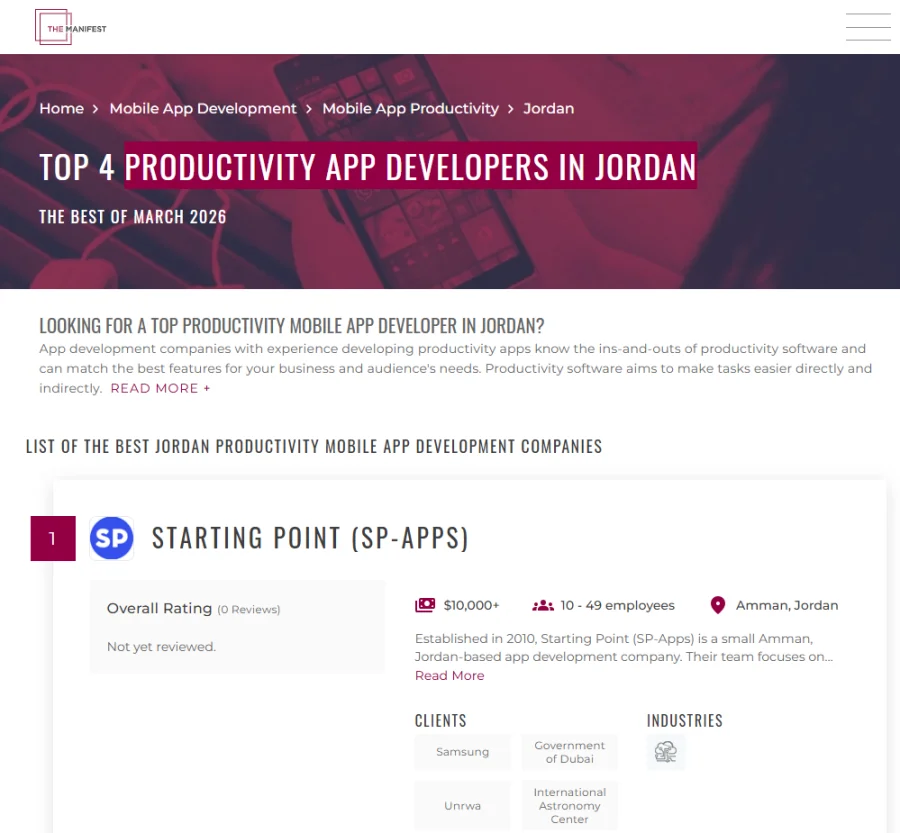
Starting Point (SP-Apps) is The Best of March 2026 Top Productivity App Developers in Jordan
Starting Point (SP-Apps) proudly ranks #1 in the Top Productivity App Developers in Jordan list for March 2026 by The Manifest. With over a decade of experience and a portfolio serving global organizations, we continue to deliver scalable, user-focused solutions that drive efficiency and innovation.

17
Dec 2025
Your Trusted Partner in App and Web Development
Choosing the right technology partner is a critical step in any digital project. At SP Apps, we work as a true partner, sharing our clients’ vision and transforming it into effective digital solutions.
We focus on building mobile applications and websites with modern design, strong performance, and intuitive user experience. Our goal is to deliver complete solutions that satisfy end users and achieve business objectives.
With SP Apps, you gain more than a service. You gain a reliable long term partnership built on trust and professionalism.

17
Dec 2011
Arabic Audio book App
SP-Apps Released first Arabic audio book Android App for Masmoo3, this app is one of many more apps that will be released gradually on Android Market for Masmoo3. Masmoo3 is the first company specialized production and dissemination of digital audio books in the Arab world.
17
Dec 2011
Smile Camera
SP-Apps released Smile Camera App for Tech Art software. Smile Camera is a photo editing & face tagging fun app. Smile Camera got more than 7,000 download in very short period of time and it is increasing.
07
Feb 2020
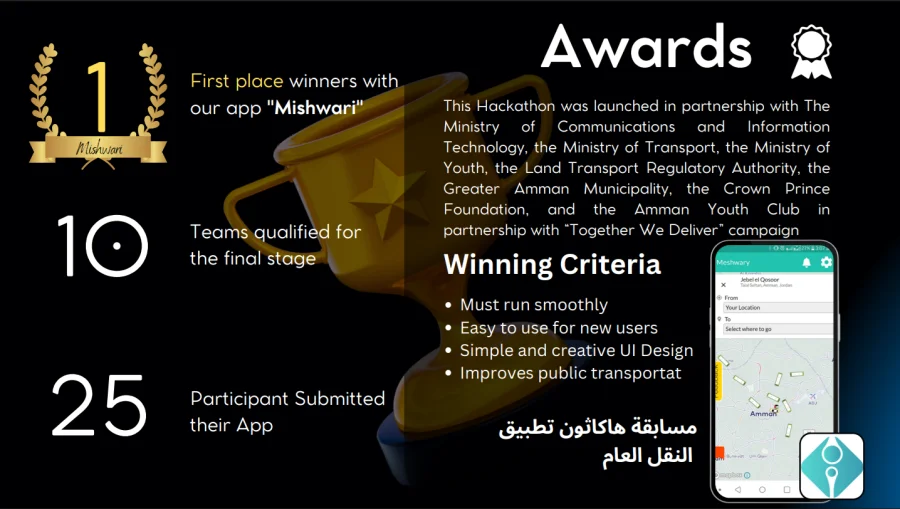
SP-Apps 1st Place Winner - Best App in Public Transportation Hackathon
We've won the 1st Place for the Best App in Public Transportation Hackathon
The Ministry of Communications and Information Technology announces the names of the winning teams in the Public Transport Application Hackathon - Amman
The Ministry of Communications and Information Technology announced the names of the winning teams in the Public Transport Application Development Hackathon, in the presence of supporting entities from ministries, government institutions and civil society organizations.
The first three places were won by: the Mashwari application team, which won the first prize worth 10,000 dinars, the Cyborgs Technology team won the second prize worth 5,000 dinars, and two teams won the third prize, which is Mid or Feed and Robotac, and it is worth 3,000 dinars each.
The hackathon aims to develop an application for public transport services and use it via smartphones, which includes features that facilitate the use of public transport in the Kingdom, by determining the departure and arrival times of buses, their routes and trip plans, and other features that improve public transport services and their schedules. The three winning teams were selected by a specialized jury, formed for this purpose, and included experts from several entities, "government, private sector and civil society organizations".
The Minister of Communications and Information Technology congratulated the three winning teams, and appreciated the efforts of all the teams participating in the "Hackathon", which witnessed continuous activity and work by everyone during its stages, calling on the participating teams to continue working and developing their skills and capabilities, because opportunities are always available to them, and that they are able to make change in all fields.
Minister Al-Gharaibeh said that the experimental launch of the application will be during the first quarter of next year "2019", in Jerash Governorate, to identify the most prominent problems in the experimental implementation process and solve them, and then it will be launched successively in the rest of the governorates of the Kingdom, which will contribute effectively to solving public transportation problems in terms of departure and arrival times, tracking bus routes and determining their locations and other features that users of public transportation bus services may need. He stressed that the idea of launching the "Hackathon" and making it available to Jordanian developers and innovators comes from the government's belief in the energies of Jordanian youth, entrepreneurs and innovators on the one hand, and their ability to harness technology to find appropriate and suitable solutions to contribute to solving public transportation problems on the other hand.
Gharaibeh praised the efforts of the work team at the Ministry of Communications and Information Technology, the implementer and supervisor of the "Hackathon" activities, and their continuous work and team spirit, which had a direct and effective impact on the success of the "Hackathon" activities in all its stages.
The number of teams participating in the first phase of the Hackathon reached 25 teams of Jordanian developers and innovators, 10 of which qualified for the final stage, and the winning teams in the "Hackathon" were selected by the jury. It is worth noting that the "Hackathon" was launched in partnership between the Ministry of Communications and Information Technology, the Ministry of Transport, the Ministry of Youth, the Land Transport Regulatory Commission, the Greater Amman Municipality, the Crown Prince Foundation, and the Amman Youth Club in partnership with the popular "Together We Arrive" campaign, one of the "Progress" platform campaigns, and the "Transformation" initiative, where the "Our Lines" application was built with previous efforts by "Together We Arrive" volunteers who worked on issuing the first map of transportation lines in Amman, and issuing an application in 2017, and also in partnership with the Jordanian Hashemite Fund for Human Development, the Ana Atalam Foundation, the Jordanian Open Source Association, the Karak Creativity Club, and the Integrated Transport Company, and cooperation was made with the Family Company for Media Artistic Production to prepare promotional videos for the "Hackathon"
23
Jun 2020
Tawjihi Academy
In Cooperation with Samsung Electronics Levant, SP-Apps developed the First Android Tawjihi Application.
Samsung Electronics Levant, the leading mobile phone provider, in collaboration with Tawjihi Academy, announced launching its first application for Tawjihi students which is exclusively available in Samsung app store.
The new application is designed for Samsung's clients who use android smartphones and tabs. It also suits the users of Galaxy Y mobiles and Galaxy tab 7.0 which all provide features of smart devices for the young generation with affordable prices.
Commenting on the launch of this application, Mr. Sangsuk Roh, president of Samsung Electronics Levant, said: "This new application is yet another step we took to meet our client’s needs. Now, we are recognizing the widening platform of the younger generation consumer group, and are paying more attention to their demands and expectations, our smart devices and applications meet their needs, making their experience easier and smarter."
Numerous are the features which this application provides to its users, such as download and display book summaries and experimental tests prepared by elite Jordanian teachers for all secondary curricula, in addition to downloading and displaying papers of all Ministry of Education previous exams. Users of this application can also check their preparations for the ministry's official exams via electronic tests.

11
Jun 2025
Builder.ai Disaster!
Builder.ai Disaster!
What’s Beneath the Surface – New Information
💥 The investors (including Microsoft, the Qatar Investment Authority, and others) were aware before investing that the company had hired programmers to do most of the coding work, while claiming it was AI-driven!
💥 Amazon accelerated the company’s collapse by filing a request with Indian authorities to liquidate the company and declare it bankrupt, after it failed to pay over $88 million in debts related to Amazon's cloud services.
💥 The company hired the Israeli firm "Shibumi"—nicknamed the "mercenary Mossad" for its work in corporate espionage and crisis handling using legal and illegal methods—to try to contain the crisis and legal violations.
Full investigation by the Financial Times https://www.ft.com/content/16ee837a-1d89-448b-8a33-9741025334d6